|
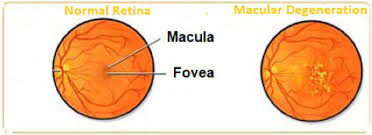
Many people accept vision decline as a normal part of the human aging process. While this is largely true, certain changes which lead to serious diseases of the eyes can be prevented from progressing into the loss of visual function if caught in time. Age related macular degeneration (AMD) is one such condition. The leading cause of vision loss among people over the age of 50, AMD is a gradual deterioration of the macula, the central part of the retina at the back of the eye which is responsible for sharp central vision. Because the vision loss is gradual, many people with AMD are unaware of it in the early stages, but signs of it can be detected by your optometrist before you experience problems, which is why it is important to have regular eye examinations. Wet and Dry Macular Degeneration
There are two main types of age-related macular degeneration, wet and dry. The vision loss from dry AMD happens slowly and is usually not as severe as that from wet AMD. In a small percentage of cases, dry AMD can lead to the wet form. Most people with AMD have the dry form, which is linked to deposits on the macula called drusen. These consist of cellular products, which are thought to be waste products from the retina. A few small drusen are unlikely to cause vision problems, but as they become bigger and more numerous and the macula becomes thinner, vision may become distorted and a blurred spot in central vision may appear. In an eye examination, your optometrist is able to observe drusen on the retina before vision is affected and will monitor them regularly for changes. Wet AMD is less common but more serious than dry AMD, progressing more rapidly and causing more severe vision loss. It occurs as extra abnormal blood vessels develop underneath the macula. These vessels leak blood and other fluids, leading to distorted vision and blind spots, eventually forming a scar and resulting in permanent damage and loss of central vision. Risk Factors for AMD
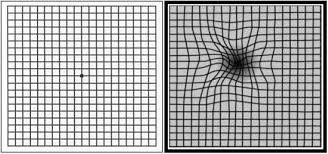
The risk for developing macular degeneration involves an interaction between genetic, environmental and lifestyle factors. As the name implies, AMD is more common in people over the age of 50. It occurs more frequently in females than males. Other factors that may contribute to the risk include high blood pressure, heart disease, obesity, a diet high in fat and sugar and certain medications. Smoking increases the risk because it reduces the amount of oxygen that goes to different parts of the body, including the eyes. The chances of AMD may increase following cataract surgery. Symptoms of AMD In the initial stages of the disease there may be no noticeable signs or symptoms. As it progresses, you may become aware of a gradual or sudden change in the quality of your vision. Straight lines may appear wavy or distorted and there may be dark blurry areas in your central vision. Reading of fine print may become difficult. In certain cases, there may be a change in the perception of colour. Diagnosis of AMD
A routine eye examination can detect age-related macular degeneration before vison changes are noticed. One of the most common early signs is drusen, tiny yellow spots under the retina. As part of the assessment, the optometrist may use an Amsler grid, a pattern of straight lines. If the lines appear wavy or some lines are missing, this could be an indication of AMD. Procedures may be performed to detect new or leaking blood vessels or the presence of fluid or blood beneath the retina. Once the diagnosis has been made, it is essential to have regular eye examinations to monitor the progress of the condition. Treatment of AMD There is no cure for macular degeneration and lost vision cannot be restored, but certain treatments can slow the progression of the disease. Research is ongoing into measures to be put in place and effective treatment to be administered before irreversible damage to the tissues in the eye can occur. Discuss treatment options with your optometrist who will refer you to an ophthalmologist if necessary. With dry AMD, it has been found that there may be some benefit to taking nutritional supplements of vitamin C, vitamin E, lutein, zeaxanthin, zinc and copper, and to include foods rich in these nutrients in the diet. To help treat wet AMD, medication is available to block the creation of new blood vessels and reduce leaking of blood. Laser therapy may be effective in destroying abnormal blood vessels. There is rarely total loss of vision with AMD. Low vision aids are available to help people make the most of their remaining vision and continue with their daily activities as much as possible. Adjusting to Life with AMD In addition to affecting activities of daily life, AMD may have an emotional and social impact. Many people are afraid of becoming less self-sufficient and more dependent on others as the condition worsens. "It can feel socially isolating. It can make me feel awkward and self-conscious when someone can see me, but I can't see them." Some lifestyle adjustments may need to be made to accommodate the difficulties. One sufferer commented that "Its OK to cry at the diagnosis but then its important to realise all the good things you have and to get on with living".
Taking care of oneself with exercise, a healthy diet and not smoking can reduce the risk for AMD and possibly slow its progression. Consult your optometrist on issues such as nutritional supplements, vision aids and technology that would be helpful, such as audiobooks and electronic readers. Establish a support system. Although it is not easy for some people, ask for and accept help when necessary. "I have dealt with my share of sadness over having AMD, but sadness is definitely not the word that comes up for me when thinking about my life. Challenge? Sure. Adventure? Yes. Joy? Absolutely." |
||||||||||||||||