|
The visual system is the most complex sensory system in the human body, but is the least mature at birth, constantly changing and evolving as the child grows and develops. Although babies are born with the structures for sight, they need to learn to use them over time. While having a basic timeline for vision development is a helpful guide for parents to know what to expect at certain ages, it is important to recognise that children reach their developmental milestones at their own pace, and that some stages may overlap. In utero, the baby's eyes begin growing at about week 4 of pregnancy. Although he can perceive light at about week 16, the eyelids remain closed until 26 weeks. Visual development begins the moment the baby is born and develops rapidly. At birth the world appears fuzzy but will go from blurry to bright in a few months. Some new-borns look directly at a face after birth, while others keep their eyes tightly shut. BIRTH TO ONE MONTH
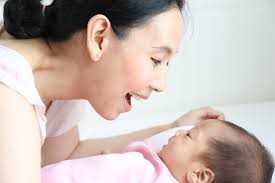
At first all the baby will be able to see is the distance from the caregiver's arms to their face, about the distance from his face to the face of the person feeding him. By two to three weeks, he will begin to focus on faces for a few seconds. As he focuses for longer, he will begin to make eye contact. The baby sees only in black and white, and shades of grey because the nerve cells in the brain and retina are not yet fully developed. His eyes are not very sensitive to light, so his sleep will not be disturbed if he is in a light room. Stimulate the baby's vision by talking to him, smiling at him and placing bold-pattern toys in front of him. He may begin to look at objects and faces on either side of him by turning his head from side to side. He won't be able to track objects without moving his head until two to four months. Although babies cry, they do not produce tears until the tear glands develop. |
||||
|
TWO TO THREE MONTHS
Although his vison is still fairly blurry, the baby will begin to recognise familiar faces and respond to smiles with a smile of his own. He is starting to notice different colours. Baby's hands and feet are fascinating to him as he stares at them intently. He becomes easily distracted by interesting objects and begins to reach for things as hand-eye coordination starts to emerge. The eyes are beginning to move independently of the head as he tracks moving objects. For the first two months of life an infant's eyes are not well coordinated and may cross or wander. This will usually go away, but if it continues, or if one eye is constantly turned in or out, the baby should be seen by a medical specialist. |
||||
|
THREE TO SIX MONTHS
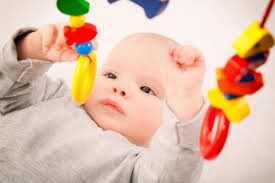
By six months, the eyes are working together effectively, and the baby is seeing the world in three dimensions. He is able to reach for and grasp objects more accurately. Colour vision has improved, and he may be showing colour preferences. The baby is now able to move his gaze and track objects without having to move his head. He watches toys falling or rolling away. Play peek-a-boo or hide toys and then reveal them to develop visual memory. Encourage his visual attention by presenting interesting colourful objects, including noise-making toys that enhance listening and strengthen the connection between vision and hearing. A baby is never too young to be introduced to books – choose books with bright simple pictures of familiar objects. |
||||
|
SIX TO TWELVE MONTHS
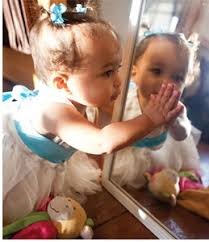
During this period rapid development takes place in all areas as the baby learns to sit, crawl and explore his world. Vision becomes more refined and becomes coordinated with body movements. The baby will be able to judge distances with more accuracy and will attempt to reach something of interest to him a short distance away. He notices small objects and is able to manipulate them more easily. He enjoys looking at his reflection in the mirror. By the end of his first year the baby has good colour vision, differentiates between near and far, recognises pictures and shows sustained visual interest. Provide toys that can be pushed or pulled, as well as simple building toys and toys that can be taken apart and fitted together, to enhance hand-eye coordination and encourage visual perceptual skills such as discrimination between sizes and shapes. Toddlers continue to refine their visual skills as they explore and learn about their visual world. During their preschool years, pre-reading and pre-writing skills develop, and by the time the child enters school he should be ready to face the demands of learning. He should have clear and comfortable vision and be able to change his focus from near to far quickly, smoothly and accurately. He should have mastered the necessary visual skills to facilitate success in the classroom. These include visual attention, discrimination, memory, sequencing, association and hand-eye coordination. Parents play a vital role in their child's visual health and development from birth right up to puberty. Provide age-appropriate opportunities for stimulation and enhancement of visual skills and be aware of signs that may indicate a vision problem. If there is a problem, the earlier it is detected and treated, the better the chances for a good outcome. |
||||