 |
||||
|
Long before cameras existed, nature had already perfected the design of the human eye, and many people wonder if the camera functions like the human eye. While the human eye and the camera are both optical systems and are similar in some ways, they differ significantly in the way they capture and process images. The eye is a biological organ which uses biological mechanisms to capture and process visual images. The camera, on the other hand, is a technological device which operates with mechanical parts. It is a tool for capturing images, without the processing power of the brain. FOCUSING ON AN IMAGE The cornea and lens in the front of the eye are responsible for focusing light to create a sharp image as it enters the eye. Unlike the camera lens which may need to be changed, and which needs to be adjusted manually, the eye’s lens does it automatically. Tiny muscles contract and relax constantly, enabling the lens of the eye to change shape and bring objects at different distances into sharp focus. SENSITIVITY TO LIGHT
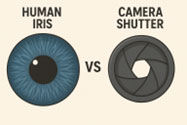
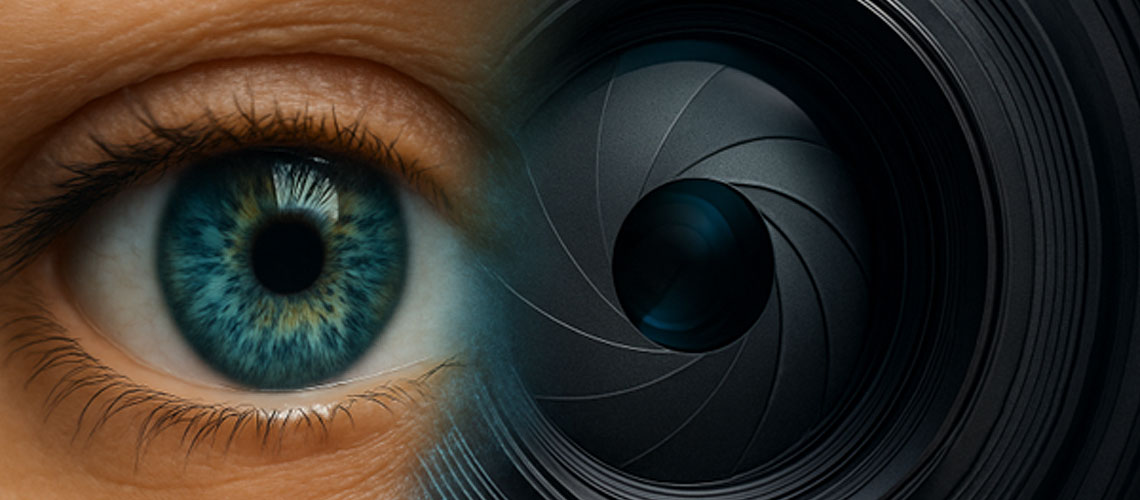
Both the camera and the eye are able to control the amount of light that enters. In photography, the aperture of the camera regulates how much light passes through the lens. In the eye, the iris — the coloured part — performs the same function. When it’s bright outside, the pupil contracts to reduce light, and when it’s dim, it dilates to let more light in. The human eye has an exceptionally wide dynamic range, allowing us to see in both bright sunlight and very low-light conditions. Many cameras, especially smartphone cameras, have limited or fixed apertures and often rely on external light sources or electronic adjustments to cope with changing lighting. The eye, by contrast, comes with its own built-in light meter — no technology required. |
||||
|
THE RETINA VERSUS DIGITAL SENSOR
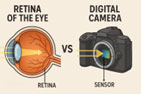
Both the eye and the camera capture an image on a light-sensitive surface. Once light travels through the lens of the eye, it lands on the rods and cones, tiny light sensitive cells on the retina. The rods help us see in low light, while the cones are responsible for colour vision and detail. Together, they convert light into electrical signals, which are sent to the brain where they are processed. The camera uses photosites (light-sensitive pixels) distributed on a sensor to collect light. A typical camera has millions of these light collectors that hold the light and then convert it into a signal that can be interpreted by electronic devices. For colour, cameras use filters that break light into its primary colours and combines these to reproduce the full colour spectrum. |
||||
|
THE OPTIC NERVE, THE CABLE TO THE BRAIN The brain is the ultimate processor. The image produced by the eyes is transferred as electrical signals along the optic nerve to the brain where the visual information we receive is turned into a rich detailed picture. The image produced by a camera is transferred as electrical signals to a memory card, where it is saved. THE BLIND SPOT At the point where the optic nerve connects to the retina, the human eye has a blind spot which is not sensitive to light. Under normal circumstances, we do not notice this blind spot as the brain uses information from the other eye to complete the missing portion of the image. The sensor of the camera is sensitive to light across its entire surface and does not have a blind spot. PERCEPTION VERSUS RECORDING The eyes “look”, the brain “sees”. The brain processes visual signals to create a three-dimensional perception of the world. Making subjective interpretations, it makes sense of what is seen by filling in details based on our expectations and interests, the environment, our previous knowledge and our past experiences. The camera records an objective, flat, two-dimensional image based on the light it captures, without the brain's subjective interpretation. Unlike the camera which snaps and records a picture, our eyes receive a continuous flow of images which the brain processes. Just like a camera, the eyes need regular care to function optimally and stay in top condition. Regular eye examinations are like giving a camera a professional service, ensuring that everything remains focused, balanced and bright, keeping nature’s most advanced camera in picture-perfect shape! |
||||