BLIND BUT NOT BEHIND
|
What can a runner who can't see teach us about the way we look at the world? June is traditionally the month of the Comrades Marathon, the so-called Ultimate Human Race. It was established in memory of the fallen South African soldiers in World War I. The first race had 34 participants, started outside the City Hall in Pietermaritzburg and ended in Durban. It has continued every year since then with the exception of the war years 1941 – 1945, and more recently 2020 with the restrictions due to COVID19. 2021 is its centenary year, but unfortunately, due to the ongoing pandemic, some of the planned activities have been cancelled, but runners will participate in virtual races.
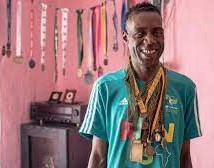
The challenge, spirit and camaraderie of the Comrades Marathon attracts thousands of people from around the world, many returning year after year. It has been completed by numerous runners with various disabilities, including blind runner Richard Monisi who completed the race 12 times. Richard grew up in a rural village in Limpopo. As a child, he didn't realise he had a disability. He often bumped into things, and fell, but was unaware that he was different from other children who might fall. Each time, he got up and carried on playing. Falling and getting up again is what Richard continued to do his whole life. It was at the age of 12, when he was hospitalised for typhoid fever, that Richard's eyes were examined, and it was confirmed that he was blind. Doctors were able to operate on his left eye and he regained 5% vision, enough to differentiate vague shapes and colours. They began to teach him how to use touch to identify objects. He learnt that "the eyes are not the only way of seeing". On his behalf, the doctors applied to the Pretoria School for the Blind, where Richard finally gained access to the facilities and equipment he needed to learn and participate in sports. Because of his age and having started school late, he was unable to finish school. He decided to move to Johannesburg. |
||||||||
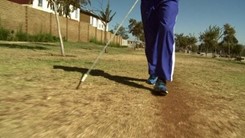
After a few difficult months during which he was forced to beg for food, Richard was offered a challenge by the founder of Rocky Road Runners. "You have a good physique – tall and slender," he observed. "Even though you're blind, you'd make a good runner. If you stop begging and start running, I promise to support you." Richard was given accommodation and help with finding a job and started training with his mentor. Once he was independent, he continued training on his own. He ran in the early hours of the morning, the quietest time of day devoid of noise that would interfere with the senses through which he was able to navigate. To guide himself, he used a combination of hearing, touch and a cane. And so his passion for long-distance running was born. Richard began to enter events, including Comrades.
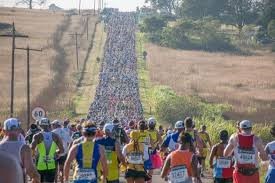
For most runners, the start of the Comrades Marathon is filled with excitement and anticipation. For Richard it is overwhelming and disorientating. Thousands of people talking and making nervous noise, loud music blaring, and then the famous cock crow signalling the start of the race. Once the number of runners has thinned out, he is able to run using the cues he is used to, guided by his other senses. Initially, he ran with a guide but later decided to go it alone. On occasion, he takes a wrong turn or misses the table where he could receive water, but the encouragement of the other runners helps him get back on track. Entering the stadium with its cacophony of cheering and music disorientates and confuses him again. In one race, unsure of the way, he fell, but the runners around him picked him up, and their camaraderie carried him to the finish line. So, what can a runner who can't see teach us about the way we look at the world? In Richard's words: "whatever hand life deals you, you don't have to give in to it. You just need to find a different way of... looking at it." |
||||||||