REFRACTIVE ERRORS
|
Light enters the eye through the cornea, travels through the lens and is bent, or refracted, by other surfaces in the eye before reaching the retina at the back of the eye. If anything prevents the light from being focused correctly on the retina, a refractive error occurs and the image that we see will be affected. Refractive errors are the most common vision problems. They are usually the result of an eyeball that is too short or too long, a cornea that is irregularly shaped, an aging lens, or a lens that is curved too much or too little. The main types are myopia, hyperopia, astigmatism and presbyopia. MYOPIA (SHORTSIGHTEDNESS)
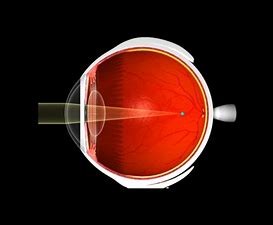
Myopia occurs when the eyeball is too long, causing light rays to focus in front of the retina, rather than directly on its surface. Another possible cause may be that the cornea and/or lens is too curved for the length of the eyeball. In some cases, myopia is due to a combination of these factors. It typically starts developing in childhood and can progress slowly or more rapidly. Myopia makes distant objects appear blurry, while near vision is clear. Other symptoms may include squinting, excessive blinking, frequent rubbing of the eyes, eyestrain, headaches and difficulty seeing clearly while driving or watching TV. It can be corrected with glasses, contact lenses or refractive surgery. Depending on the degree of myopia, glasses or contact lenses may need to be worn all the time or only when clear distance vision is needed, for example in the classroom, watching a movie or driving. |
||||
|
HYPEROPIA (FARSIGHTEDNESS)
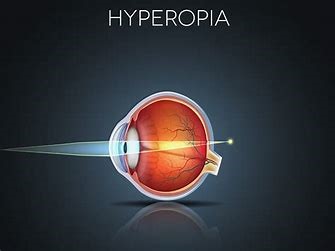
People with hyperopia can see distant objects clearly but have difficulty focusing on objects that are up close. It occurs when the eyeball is shorter than it should be. Hyperopia is usually present at birth. Some children grow out of it as the curvature of the eye lengthens to normal, while others remain the same or experience worsening vision. Common symptoms of hyperopia include difficulty focusing up close, eyestrain, headaches and eye fatigue after doing close tasks such as reading or sewing. Glasses, contact lenses or corrective surgery can treat hyperopia successfully. It may be necessary to wear glasses or contact lenses all the time or only when doing close work. |
||||
|
ASTIGMATISM
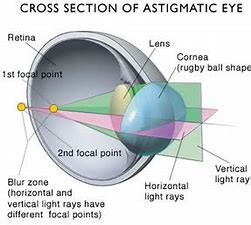
In an eye with astigmatism, instead of a single focus point of light on the retina, multiple focus points occur, either in front of the retina or behind it or both. This is usually caused by an irregularly shaped cornea, more like a rugby ball than a symmetrically shaped soccer ball. Less commonly, the lens of the eye is the incorrect shape. Astigmatism often occurs with myopia or hyperopia. Symptoms of astigmatism include blurry vision for distance or close up, fluctuating vision, eye strain, headaches, difficulty seeing at night and glare or halos around lights. Like other refractive errors, it can usually be corrected with glasses, contact lenses or refractive surgery. |
||||
|
PRESBYOPIA
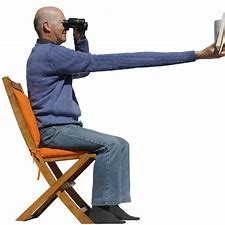
Presbyopia is part of the normal process of aging as the lens of the eye begins to harden and become less flexible. Most people begin to notice the effects of presbyopia after the age of 40, as it becomes more and more difficult to read small print, particularly in dim lighting, and they need to hold reading material further away to see it clearly. Some people also experience increased sensitivity to light and glare. Presbyopia can be treated with glasses, including prescription reading glasses, bifocals, trifocals, or progressive lenses. Photochromic lenses are an effective solution to the light sensitivity. Bifocal or monovision contact lenses and refractive surgery may be further options. |
||||
|
OTHER REFRACTIVE ERRORS Refractive errors may occur as symptoms of eye disorders and diseases or independently. Poor Contrast Sensitivity Poor contrast sensitivity is the inability or difficulty telling the difference between an item and its background. It can be part of several conditions, including cataracts, glaucoma, macular degeneration, and diabetes. Symptoms include problems driving at night or in poor visibility conditions, locating objects against a similarly coloured background, going up or down steps or curbs, and differentiating facial features. The treatment depends on the cause, and may include eye drops, eye injections, or surgery. Anisometropia Anisometropia is a condition in which the eyes have unequal refractive power, making it difficult to focus. It may be the result of a refractive error in one eye but not the other or opposing refractive errors in the eyes. The person with this condition may experience blurred vision, poor depth perception, dizziness, headaches, nausea or "lazy eye". Anisometropia is treated with corrective lenses, contact lenses, or laser eye surgery. During a regular routine eye examination, your optometrist can detect and diagnose refractive errors and recommend treatment options. Untreated refractive errors can lead to worsening vision, amblyopia (lazy eye) and other visual problems. Poor performance in the classroom or on the sports field can be the result of a refractive error, which can generally be easily treated if picked up timeously by your optometrist. |
||||