WET VS DRY MACULAR DEGENERATION

|
Age-related macular degeneration (AMD) is a progressive condition, which is the leading cause of severe vision loss in adults over 50 years of age. It affects the macular, the central part of the retina which is responsible for sharp central vision and for seeing detail. Without central vision, it is difficult to recognise faces, read or drive. Because the vision loss is gradual, many people with AMD are unaware of it in the early stages and may notice the changes to their vision only once the disease is more advanced and irreversible vision loss has occurred. Early signs can be detected by an optometrist in a comprehensive eye examination before visual problems are experienced, and steps can be taken to slow the progression of the disease and the deterioration of the macula. There are two main types of macular degeneration, wet and dry. Dry AMD is the more common and less severe form of the condition. The difference between them is determined by the cause of the macular distortion. With wet AMD, the function of the macula is impeded by the growth and leakage of abnormal blood vessels beneath the retina. Dry AMD is the result of aging and the thinning of the macula over time. These divergent causes result in different treatments and prognoses. SYMPTOMS
The specific symptoms and progression of AMD depend on the type of AMD as well as other individual health factors. People who have dry AMD may experience vision problems, but these are typically less severe and progress more slowly than those of people with wet AMD. Early dry AMD usually shows no symptoms and signs of vision changes may go unnoticed. It is identified during a routine dilated eye examination. During the intermediate stage, some people still experience no symptoms, while others begin to experience minor blurriness in central vision and gradual difficulty seeing in low light. Later stage symptoms may include less sharp vision with some blank spots, and straight lines may be seen as wavy. Once dry AMD progresses further, the symptoms are similar to those of wet AMD. Symptoms of wet AMD include blank spots, a blurry area in central vision, the appearance of colours being faded or less vivid, and straight lines seen as warped or wavy. Without treatment, most people with wet AMD will experience considerable and permanent vision loss. In about 10% of cases, dry AMD can become wet AMD. Since there is no way to predict this, it is critical that AMD is regularly monitored by an optometrist. During dry AMD, drusen, clusters made up of fats and proteins, build up under the macula. Large drusen that interfere with central vision are a defining feature of AMD. Wet AMD happens when irregular blood vessels begin to grow under the macula. These blood vessels leak fluid into the retina and reduce vision. Over time, scarring within the retina may occur. It is not known exactly why AMD develops, but there are certain associated factors which increase the risk. These include the presence of drusen, a family history of AMD, smoking, high blood pressure and obesity. Age is the most important of all of the AMD risk factors. People over the age of 55 are at a higher risk and that risk increases with time. During the aging process, changes occur to the retina that make AMD more likely to develop. Some studies suggest that AMD is more common among females, but more research is necessary to support this. DIAGNOSIS
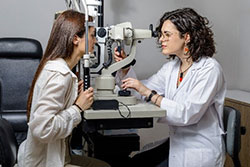
AMD is diagnosed by means of a comprehensive eye examination. People with dry AMD will exhibit changes in the cell layer underneath the retina, are likely have drusen deposits in the eye and may experience damage to the retina itself. People with wet AMD may have fluid buildup around the retina as well as waste deposits around the macula. There may be discoloration due to bleeding below the macula as well as evidence of bleeding within or near the macula. To confirm the diagnosis, further testing may be indicated. This may include injecting dye that travels to the blood vessels of the eyes to determine whether there is leakage in the blood vessels, a sure sign of wet AMD. |
||||||||
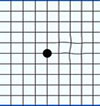
The Amsler grid, a black grid with a black dot in the middle, is commonly used to test for blurry or blank spots in the field of vision. With AMD, the lines will appear wavy, distorted or blurred. Optical coherence tomography (OCT) is a test used to diagnose various eye conditions. A special light beam scans multiple layers of the eye's tissues, generating high quality, cross-sectional images. It is possible to have AMD alongside other eye conditions such as cataracts or glaucoma. Regular eye examinations are crucial so that any progressive eye condition can be detected early, treated and monitored over time to facilitate the most positive outcome. TREATMENT AND MANAGEMENT
When the condition is diagnosed early, some treatments may slow the progression of macular degeneration, but none of them can undo the vision damage. With dry AMD, the tissue of the macula gradually becomes thin and stops working effectively. There is no cure for dry AMD, and any loss in central vision cannot be restored. However, there is a link between nutrition and the progression of dry AMD. Making dietary changes and taking nutritional supplements can prevent it from worsening. These nutrients include vitamins C and E, zinc, omega 3, lutein and zeaxanthin. Additionally, eating nutrient-rich foods, like dark, leafy greens, vegetables, and fatty fish, has been shown to help some people with dry AMD. Research is underway to find other dry AMD treatments, including drugs that target the part of the body's immune system that attacks the retinal cells. Less common, wet AMD occurs when fluids leak from newly formed blood vessels under the macula, causing rapid central vision loss. If detected early, wet AMD can be treated with intraocular injections or medications that block the abnormal growth of new blood vessels. The intermediate and advanced stages of wet AMD do not respond to dietary changes or supplements. By maintaining a healthy lifestyle and having an optometrist check their eyes regularly, people with AMD can maximise their quality of life for years to come. |
||||||||