WHY "MINT GREEN"??

|
Toothpaste! Mouthwash! Ice cream Soda! These are just a few of the comparisons made by Springbok rugby fans as they expressed outrage, anger and disbelief at the colour of the kit worn by the Springboks in their first Rugby World Cup match against Scotland. What could possibly be the reason behind choosing a colour that does not reflect or represent our national colours or our proud heritage? According to the Rugby World Cup organisers, there is a valid reason: the new policy "caters to fans, players and even match officials with color vision deficiency, commonly known as color blindness". Teams are encouraged to choose colours that avoid clashes in situations where the colours of two teams may "appear too similar or lack contrast". What is colour blindness? Colour blindness is a misleading term as it is extremely rare to be unable to see any colours at all. A more accurate term is colour vision deficiency, a condition in which people see colours differently, see a limited range of colours, are unable to differentiate between shades of similar colours, or have difficulty seeing the brightness of certain colours. How do we see colour? The human eye contains millions of light-sensitive cone cells which work together to detect colour in the visible spectrum of light. When light enters the eye, it is translated into signals that are transmitted to the brain where the sensation of colour is experienced. There are three types of cones that see colour, red, green and blue. With full colour vision, all three types of cones are present and working properly and we see all colours on the visible spectrum of light in the traditional way. How do people with colour vision deficiency see colour? Colour vision deficiency is caused by a change or reduction of sensitivity of one or more of the light-sensitive cone cells in the eye. When one of the cone cells is absent, not functioning effectively or detects a different colour than normal, colour vision deficiency occurs. Except in its most severe form, colour vision deficiency does not affect sharpness or clarity of vision. There are several types and degrees of colour vision deficiency, depending on which cones are not functioning well. Some people with mild colour deficiencies can see colours normally in good light but have difficulty in dim light. Others cannot distinguish certain colours in any light. The most severe form of colour vison deficiency, in which everything is seen in shades of grey, is uncommon. How common is colour vision deficiency? Overall, around 300 million people around the world have some form of colour vision deficiency. Red-green colour vision deficiency, the most common type, affects about 1 in 12 males and 1 in 200 females, while blue-yellow colour vision deficiency affects about 1 in 10,000 people. What causes colour vision deficiency? Most people with colour vision deficiency are born with it. Congenital colour vision defects usually pass from mother to son. Colour vision deficiency can be acquired later in life due to certain eye diseases, medical conditions, medications, trauma or exposure to environmental factors. Acquired colour defects are less common than inherited forms and usually develop as blue-yellow colour deficiency. How is colour vision deficiency diagnosed?
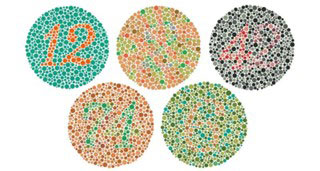
Several different tests are used by optometrists to diagnose colour vision deficiencies. The most commonly used test uses patterns made up of multi-coloured dots. If the person does not have colour deficiency, he will be able to see numbers and shapes among the dots, but it will be difficult, or impossible in severe cases, to detect these if there is a colour vision deficiency. |
||||
|
Can colour vision deficiency be treated? Currently, there is no medical treatment or cure for people with inherited colour vision deficiency. Glasses and contact lenses are available to provide a richer colour experience in mild forms of the condition, but the results vary from individual to individual. With the acquired condition, the underlying condition needs to be treated by a healthcare specialist. How does colour vision deficiency affect daily life? Mild colour vision deficiency generally does not affect day-to-day life. In fact, many people are unaware that they perceive colour differently from others. More severe forms may interfere with certain areas of one's life, such as career choice and interpretation of colour-coded information. Children may have difficulty in the classroom as many tests and educational materials rely on colour to convey information or measure learning. Sport is an area where colour vision deficiency may inhibit some from playing at their full potential. People with colour vision deficiency may not experience the vibrant colours of an everyday event, a spectacular sunset. The lower light conditions at sunset coupled with the presence of red in most of its colours may make a sunset look more muted. At the end of the day, no matter what colour shirts the Springboks wear, they will always be the team that we support! |
||||