IS YOUR VISION ROADWORTHY?
 |
||||
|
Most of the information we use when driving comes through the eyes, and a large percentage of critical decisions that drivers make are based on visual cues. Our eyes control most of our movements while driving, constantly moving, focusing and refocusing as they adjust to the flow of input. Navigating the roads can be challenging and requires a combination and integration of complex skills. These include the motor ability to scan a rapidly changing environment, the sensory ability to perceive information, the attentiveness to process multiple pieces of information, the cognitive ability to judge this information and to make appropriate decisions and the motor ability to execute these decisions quickly. VISUAL ACUITY Visual acuity, the ability to see clearly, is fundamental to safe driving. A driver’s visual acuity must at least be such that he has time, while moving, to detect and to react to obstacles, pedestrians, other vehicles and road signs, in daylight and in darkness. If distance vision is poor, one may not see hazards until it's too late to react safely. PERIPHERAL VISION AND VISUAL FIELD
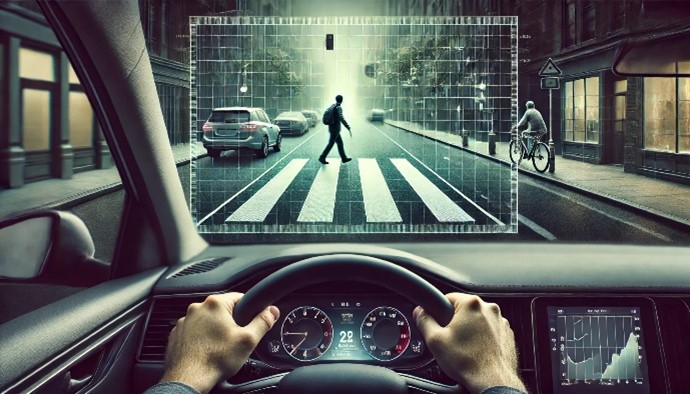
Being able to see ‘out of the corner of the eye’ without moving the head and while keeping the eyes on the road enables the driver to see cross traffic, pedestrians, cyclists, road signs and obstacles. How wide an area the eye can see while focused on a central point, the visual field, is equally important. Studies have shown that some individuals with some degree of peripheral visual field loss may develop the compensatory ability to scan the surrounding environment effectively enough to drive safely. |
||||
|
COLOUR VISION
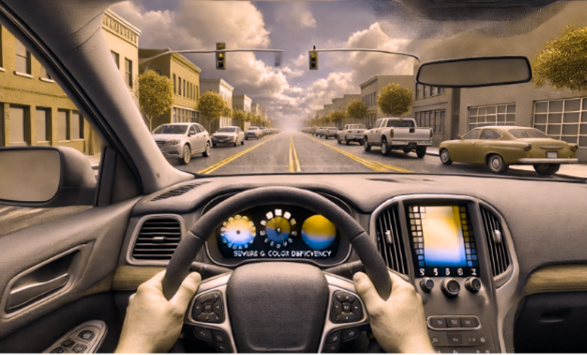
Colour plays an important part in road safety in that drivers must instantly recognise traffic lights, indicator signs and hazard warning lights. Some people with colour vision defects may react more slowly to these, particularly in bad weather or at night. |
||||
|
CONTRAST SENSITIVITY Contrast sensitivity is the ability to see details such as curbs, pedestrians, and traffic signs in adverse driving conditions like fog and darkness. Drivers with reduced contrast sensitivity may benefit by limiting their driving to the hours between dawn and dusk, and some find their contrast sensitivity improved by wearing glasses with yellow filters. DEPTH PERCEPTION Safe driving depends on depth perception, the ability to accurately judge relative distance between objects in order to change lanes and pass other vehicles, particularly in busy traffic. ACCOMMODATION When driving, one frequently needs to look from the road to the dashboard and back again. This ability to change focus from far to near quickly and smoothly is accommodation or near vision focusing. NIGHT VISION
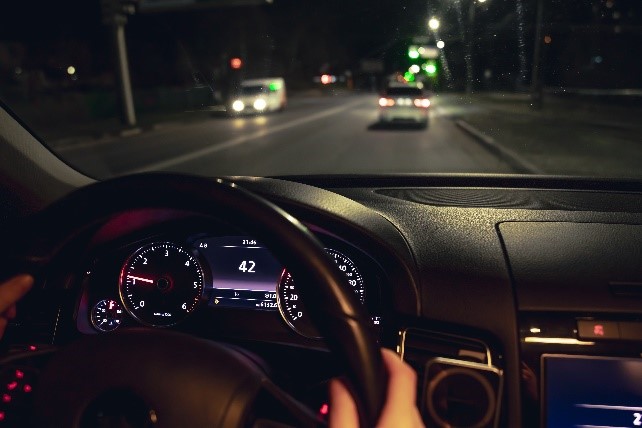
At night, lighting is poor, the eyes are slower to adapt to lower light levels and more complex visual tasks are required for safe driving. Driving in the dark requires one to focus and concentrate a lot more than when driving in daylight, sometimes leading to eye strain and fatigue. Naturally, visibility is significantly lower and there is the added challenge of glare from streetlights and oncoming headlights. Glare recovery is the speed and efficiency with which the pupil re-adapts to night conditions after being flooded with a sudden bright light, like that of oncoming traffic. |
||||
|
VISION PROBLEMS THAT CAN AFFECT DRIVING Conditions that might affect the ability to drive safely include: Myopia, or short-sightedness, a refraction error that can make it difficult for a driver to read signs, perceive hazards, and see other road users and objects clearly from far away. Presbyopia, or age-related long-sightedness, which makes it difficult to see objects up-close, such as information on the dashboard. Macular degeneration, a condition which causes gradual loss of central vision. Glaucoma, a condition that damages the optic nerve and narrows the field of vision, leading to tunnel vision over time. Diabetic retinopathy, a disease in which high blood sugar levels cause damage to the blood vessels in the retina, leading to gradual vision loss. Cataracts, a common condition, in which the lens of the eye becomes cloudy, resulting in blurred vision, increased light sensitivity, dulled colours and difficulty driving at night. Dry eye, which can lead to blurred vision, excessive tearing and eye fatigue, any of which can impair vision, especially at night. Many of these conditions cause a slowly progressing loss of vision which is often not noticeable in the early stages. Having regular eye examinations can help to detect the visual changes early and treat the eye conditions promptly before they cause irreversible vision loss.
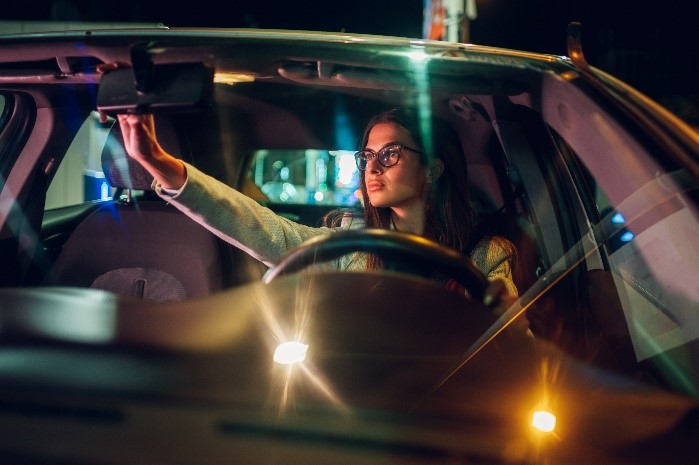
Safe driving includes ensuring that the windscreen of the car is clean and free of dust and scratches, mirrors are always properly adjusted, and headlights well maintained and properly positioned. Make sure you always wear glasses prescribed for driving and sunglasses which protect the eyes from sun glare. When driving at night and there are bright headlights from oncoming cars, recovery from the glare takes longer if you look directly into the lights; rather look slightly to the left. When driving long distances, stop regularly to rest your eyes. |
||||