THE “TETRIS EFFECT”: VISION, PERCEPTION, AND A BRAIN THAT ADAPTS
 |
||||||||
|
As children and adolescents, many of us were warned that spending too much time watching TV or playing video games was bad for our eyes. However, modern optometry is proving that in certain cases video games can be helpful in treating specific visual problems. Through a phenomenon known as neuroplasticity, we are discovering that the brain is not a static organ but can be physically reshaped by the activities we perform. One of the most fascinating examples of this is the Tetris Effect, which highlights how vision is not just about the eyes, but about how the brain interprets what we see. The visual system is highly plastic because it must constantly make sense of a fast-changing world. Vision is not a passive process. While the eyes capture light, it is the brain that constructs the final image. When we repeatedly expose the brain to certain shapes, movements, or patterns, the visual cortex becomes more efficient at recognising them.
Originally coined in the 1990s, the Tetris Effect demonstrates brain plasticity, the brain's ability to change and adapt based on repeated visual input. It describes how people who play the classic video game, Tetris, in a controlled setting begin to see the world differently. This adaptability is essential for everyday life. When we engage in a high-focus, repetitive visual task, the brain builds and strengthens new neural pathways to become more efficient at that task. In the case of Tetris, changes in the brain have been observed in areas associated with complex coordinated movement and multi-sensory integration. The Tetris Effect reminds us that vision is a partnership between the eyes and the brain. This discovery has led to a breakthrough in treating lazy eye (Amblyopia). This common childhood ailment, although it can occur in adults, can significantly affect vision. It is estimated to affect around 3 in every 100 children, in whom one eye does not develop quite as it should. |
||||||||
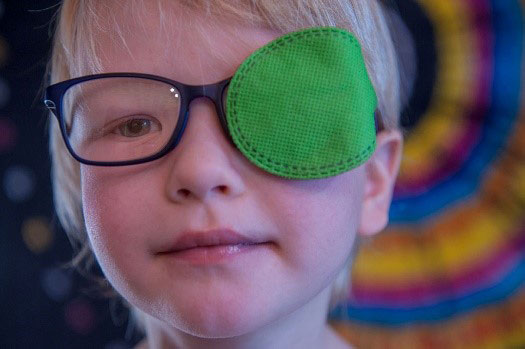
This means that the child becomes more reliant on their good eye, while the underdeveloped eye becomes increasingly “lazy” and works less effectively, often resulting in a squint. When left untreated, vision in the affected eye continues to deteriorate and can even be lost completely. Amblyopia is typically treated by compelling the weak eye to work harder. Traditionally, the standard treatment was to wear a patch over the "strong" eye to force the "weak" eye to work. Patching the stronger eye is very effective in children, particularly when diagnosis and treatment happen early; however, it can be a slow process and has been shown to have little to no effect when applied in adults. Recent research suggests that isolating the eyes may not be the only solution for treating amblyopia. Instead, it has been theorised that forcing the eyes to cooperate, rather than encouraging them to work independently, could hold the answer, and there may be a novel way to achieve this. A small study some years ago found that an adapted version of Tetris helped treat the condition.
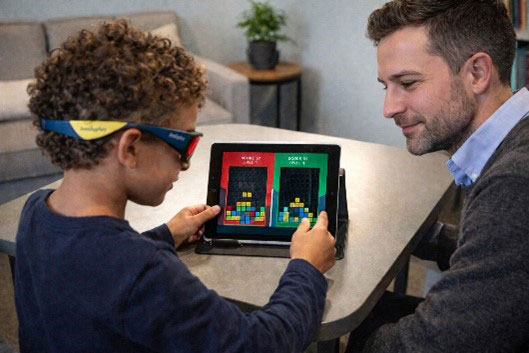
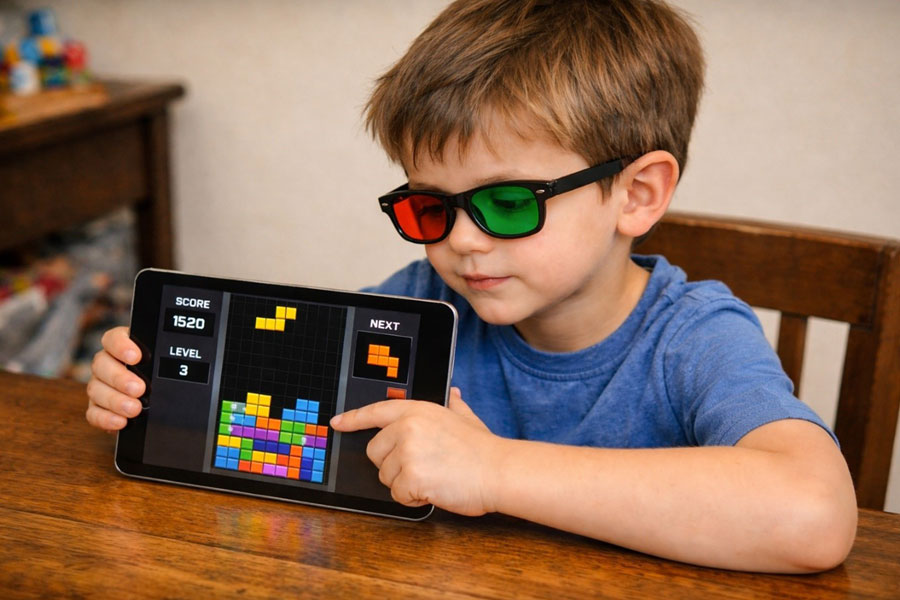
Dichoptic Tetris is a specialised version of the video game, in which the brain is required to combine the information from both eyes in order to play the game effectively. Through the process of neuroplasticity, the brain trains both eyes to work together, by suppressing the stronger eye's signals and responding to signals from the weaker eye. In a number of studies, individuals playing this version of Tetris showed significantly faster improvements in 3D depth perception and visual acuity than those using the traditional patching treatment. While Dichoptic Tetris is clearly a powerful tool for modern vision therapy and illustrates that vision can be trained at any age, this is not a licence to spend unlimited hours playing video games! Prolonged exposure to screens, repetitive visual tasks, or poor visual habits can influence how the brain processes information. Visual fatigue, after-images, and pattern persistence are signs that the brain is working hard to adapt. Because the visual system remains plastic throughout life, changes in habits, such as taking regular screen breaks, improving lighting, or engaging in targeted visual activities can positively influence how we see and process the world. |
||||||||