
READING GLASSES FOR AGING EYES

Along with greying hair, wrinkles and stiffening joints, presbyopia is one of the inevitable aspects of the normal process of aging. As we age, the lens of the eye becomes less flexible and loses its ability to quickly change focus to accommodate both close and distant objects. Added to that, the tiny muscles attached to the lens become weaker and less able to contract effectively for close-up focus.
Although the onset of presbyopia may seem to be sudden, it generally starts around the age of 40 and deteriorates gradually before vision problems are noticed. Typical symptoms of presbyopia include difficulty seeing close objects while there is no difficulty seeing distant objects, eyestrain after reading or doing close work, blurred vision, difficulty reading small print, and trouble reading or doing close work in low light. A common symptom which sometimes invites humorous comments is the need to "grow longer arms" or to hold reading material at an arm's distance away in order to focus on it.
Because everyone develops at least a certain degree of presbyopia as they age, it is possible to have presbyopia in addition to other types of vision problems, such as myopia (shortsightedness), hyperopia (farsightedness), or astigmatism (an imperfection in the curvature of the cornea). Presbyopia is sometimes confused with hyperopia because in both conditions distant objects are clear while closer objects appear blurry. However, the primary difference between them is that presbyopia affects older adults and is associated with the aging process while hyperopia can affect both children and adults and may have hereditary or environmental causes.
Recognising changes in your vision is the first step towards treating them. There are several options for managing presbyopia. A discussion with your optometrist will guide you towards the most appropriate for you, depending on your vision condition, visual needs, lifestyle and the existence of other health concerns.
The notion has been expressed that wearing reading glasses worsens near vison, but this is more myth than truth. Near vision may be continuing to decline due to the natural progression of the presbyopia whether glasses are worn or not. Wearing reading glasses can alleviate the eye strain and other symptoms associated with presbyopia, making reading and close work more comfortable. The question is whether to use over-the-counter reading glasses or have a pair of glasses with your specific prescription made by an optometrist.
 |
|
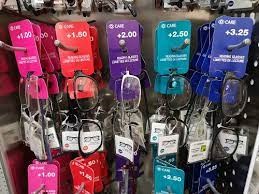
For people who have never needed to wear glasses, single vision lenses may be all that is required, and over the counter glasses are readily available, convenient and inexpensive. Although not needing an eye examination can be seen as an advantage, it is important to consult your optometrist whether for a pair of reading glasses or not, to assess your general visual health. With over-the-counter readers, the lens power is the same for both eyes, which could lead to eye strain if each eye requires a different power. They are made to a standard pupillary distance, the distance between the centres of the pupils of the eyes. If the pupillary distance is incorrect for your eyes, your vision may not be clear, resulting in eye strain. In addition, lens quality of off-the-shelf readers is often questionable and flaws and waves may contribute to headaches and eye strain. Your optometrist will advise you on what to look for when buying reading glasses off the shelf.
 |
|
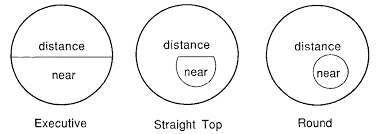
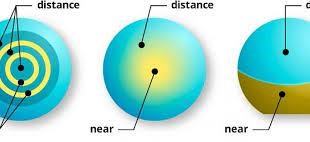
Prescription glasses are recommended for those who need lenses to correct visual problems other than presbyopia. There are three options available. Bifocal lenses have two prescriptions in one lens, the upper portion set for distance vision while the lower section is for close work or reading, with a line in between. Depending on preference, there are a few different options for bifocal lens configuration, including half-moon configuration, round segment, ribbon segment and executive style. Your optometrist can help determine which is best for you. Trifocals have points of focus for close, intermediate and distance vision, without the visible lines between each. Progressive lenses are multifocal and offer a more gradual transition between the different portions of the prescription.
 |
|
Some people find wearing glasses uncomfortable for a variety of reasons and prefer to wear contact lenses to manage their vision difficulties. Bifocal contact lenses provide the same option as bifocal glasses, with two prescriptions in one lens. Monovision contact lenses require you to wear a contact lens set for distance vision in one eye and a different contact lens set for close work in the other eye. Modified monovision contact lenses require you to wear a bifocal contact lens in one eye and a contact lens for distance in your other eye. Both eyes are used for distance, but only one eye is used for reading. The brain adjusts as needed to process the image.
 |
|
Your optometrist will refer you to an ophthalmologist if you are interested in exploring the surgical options for presbyopia. Conductive keratoplasty (CK) changes the curvature of the cornea. LASIK is performed to create monovision, with one eye corrected for near vision and the other for distance. Refractive lens exchange involves replacing the natural lens of the eye with a synthetic implant.
Given the natural progression of aging, your eyes will continue to gradually lose their ability to focus on close objects over time. It is important to visit your optometrist regularly to review your prescription as well as to check on your visual health. By examining your eyes, your optometrist may detect signs of general health problems, such as diabetes and cardiovascular disease, before symptoms manifest. Timeous referral to a medical specialist and early diagnosis and treatment lead to a better long-term prognosis.