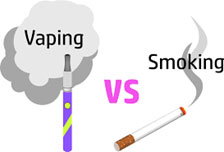
SMOKING vs. VAPING
|
The effects of smoking and its connection to many significant health conditions are well-documented. Perhaps less well known is the impact smoking has on eye health and vision. Not only does smoking damage parts of the eye critical for maintaining clear vision, it also increases the risk for the development of eye diseases such as cataracts, macular degeneration, diabetic retinopathy and dry eye. Vaping and e-cigarettes have become a popular alternative to smoking, and while the research on the impact of vaping is not as extensive as tobacco studies, the results so far indicate that it, too, has damaging effects on both general and eye health. VISION PROBLEMS CAUSED BY SMOKING DRY EYE Cigarettes contain thousands of chemicals, including many irritants that can leave the eyes red, burning, or watery. Cigarette smoke breaks down the lipid layer of the tear film that acts as a barrier against the environment, resulting in dry eye, not only for the smoker but for others exposed to the second-hand smoke. While dry eye does not cause permanent damage, it can be uncomfortable, particularly for contact lens wearers. MACULAR DEGENERATION Smokers are more likely to develop damage to their retinas, including age-related macular degeneration (AMD) which causes irreversible damage to the macula, resulting in a loss of central vision and the ability to discern fine details. This severely impacts reading, driving, facial recognition and many daily activities. As well as reduced blood flow to the retina, smokers have been found to have lower levels of the antioxidants lutein and zeaxanthin which protect the macula from ultraviolet radiation, a further risk factor for AMD. CATARACT Cataract formation is a natural consequence of aging for many people, but smoking can double the risk of cataracts at an earlier age. Smoking increases the number of highly reactive, unstable free radicals which cause fat and protein deposits to form on the eye's lens, leading to the development of cataracts. GLAUCOMA Smokers are at a higher risk of developing glaucoma by producing free radicals that damage the fibres of the optic nerve which carries visual messages to the brain. This damage can eventually lead to irreversible vision loss. DIABETIC RETINOPATHY One of the complications of diabetes is diabetic retinopathy, progressive damage to the tiny blood vessels in the eye which can lead to vision loss if not detected and treated early. Smoking increases the risk of developing diabetes and may speed up the progression of diabetic retinopathy. UVEITIS Uveitis is inflammation of the central layer of the eye, causing redness, pain, blurry vision and damage to the iris and retina. Smoking more than doubles the risk of developing uveitis. COLOUR VISION Research has shown that some problems with colour and contrast vision may be a consequence of heavy smoking and chronic exposure to the chemicals in cigarettes. “PASSIVE” SMOKING Passive smoking, or exposure to second-hand smoke, is a concern for the eye health of children, who have a higher risk of allergic conjunctivitis and the development of eye problems later in life. EFFECTS OF VAPING ON THE EYES
By providing nicotine through a heated liquid composed of flavouring and other chemicals rather than tobacco, vaping and e-cigarettes are viewed as a healthier replacement for smoking cigarettes. Research generally accepts that while vaping can harm the lungs and other bodily systems, its impact is much less than tobacco smoking. However, a 2019 study into the long-term health effects of vaping found that people using e-cigarettes had a higher risk of respiratory disease than people who never smoked. Vaping may damage the lungs, release free radicals into the body and weaken the immune system. E-cigarettes can cause oxidative stress, a key factor in the development of chronic diseases, as well as cataracts and glaucoma. Recent studies indicate that vaping has a negative impact on the eyes and that the toxins in e-cigarettes could damage vision. With constant vaping, ingredients like propylene glycol can produce cell-damaging free radicals that may weaken the fluid layer covering the surface of the eye, leading to or worsening dry eye symptoms. One study on tear function suggested that “vaping is not kind on your eyes” after finding lower quality tear film and severe dry eye in people who used vaping products. A study by the University of California found that current vapers were 34% more likely to suffer from visual impairments compared to those who had never tried vaping. While there is no definitive proof that vaping causes visual impairment it does parallel earlier studies linking smoking to eye problems. |
||||
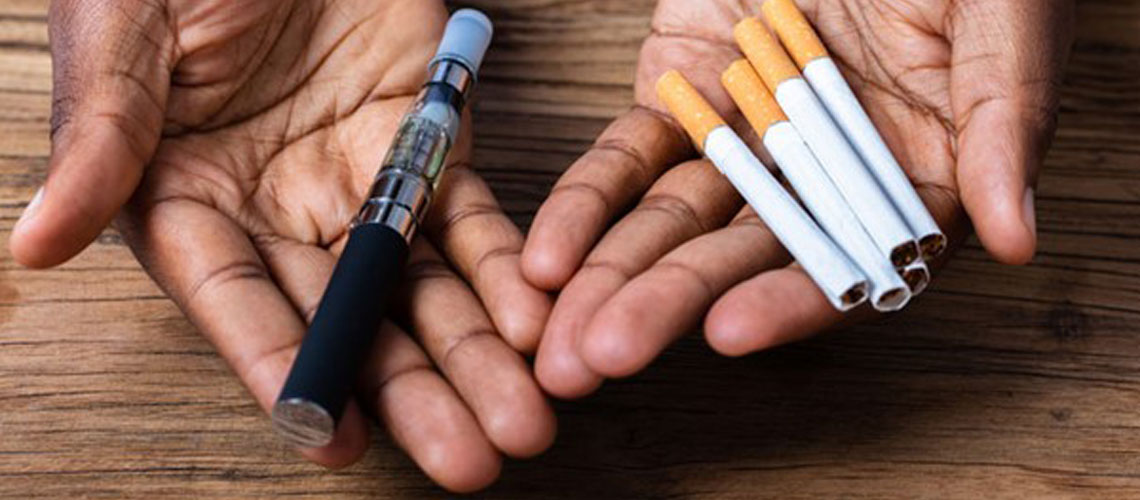
Compared to cigarette smoking vaping is a relatively recent activity. While some health authorities believe that vaping is safer than smoking, others feel that this is not necessarily the case and vaping is not risk-free. The chemicals in vaping may be harmful, but on a significantly lower level than tobacco, indicating that they carry less of a health risk than cigarettes. It is not clear whether vaping causes the same eye health concerns as regular cigarettes, but some doctors even suggest that the vision health risks of vaping may be up to four times greater than smoking regular cigarettes, though there have not been any long-term studies to prove this. It is clear that opinions are divided and there is no conclusive evidence on the lasting effects of vaping versus smoking on eye health. With the proven correlation between regular cigarette smoking and various eye diseases, it is likely that links will also be found with vaping and e-cigarettes. Further investigation is needed for a deeper understanding of the effect of e-cigarettes on the eyes. |
||||
|
||||