|
“Squinting” is a common behaviour that many people instinctively employ when they find themselves in situations where they need to see more clearly. Whether it is to decipher small print or read a distant sign, recognise a face or watch TV from across the room, this seemingly simple action does often make things look sharper. Why does this happen and is it actually helping our vision in a healthy way? The answer is underpinned by scientific and physiological principles that explain why squinting enhances our vision.
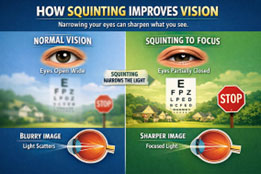
When the eyes are open normally, light enters through the pupil and is focused onto the retina. If your vision isn't perfectly corrected, for example, if you're short-sighted, long-sighted, or have astigmatism, light rays don't focus precisely on the retina. This results in blurry vision.
When you squint, you partially close your eyelids, narrowing the opening through which light enters the eye, limiting the amount of light entering. The edges of your eyelids act as a makeshift shield, blocking excess or scattered light, and allowing only more central direct light rays to reach the retina.
Squinting slightly alters the angle of incoming light, which may help focus images more precisely on the central part of the retina, enhancing our ability to perceive fine details. These three key factors improve focus and sharpness and vision is temporarily improved.
While squinting may be a helpful tactic in certain situations for improved clarity, it is not a permanent or suitable solution. It is a signal that something may be wrong, but not a correction for what the underlying cause may be. Relying on squinting can lead to several problems over and above blurry vision.
Constant squinting forces the eye muscles to work harder, leading to discomfort, eye strain and eye fatigue. The extra muscular effort and visual strain can trigger tension headaches and contribute to increased tension around the eyes.
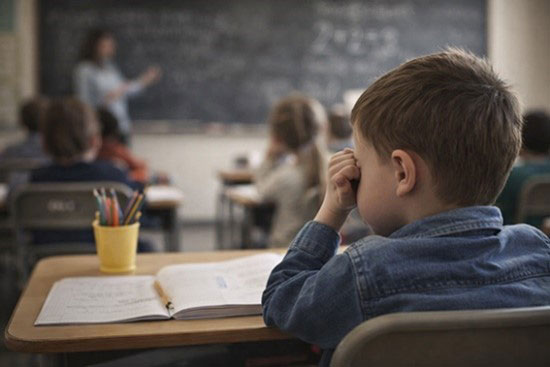
Habitual squinting can mask underlying vision problems and lead to a delayed diagnosis and treatment of a problem that should be assessed and managed by an optometrist. In children, frequent squinting can also indicate undiagnosed vision problems that may affect learning and development.
Although squinting can improve visual clarity and provide relief in the moment, it is not a permanent solution but a sign that there is a problem that needs attention. The problem might be shortsightedness (myopia), longsightedness (hyperopia), astigmatism, or age-related vision changes (presbyopia). Instead of squinting to see better, the healthiest solution is a professional eye examination. Properly prescribed glasses or contact lenses correct the way light enters your eyes, giving you clear vision without strain or effort.
Clear vision should feel relaxed, not forced.
|