
WHEN SHOULD CHILDREN GET GLASSES?
 Parents are often uncertain and confused about when children should have their eyes tested and whether they should wear glasses or not. There are a number of myths around this topic, including if young children wear glasses they will become too dependent on them, or if children wear glasses when they are young they won't need them later, or even children will outgrow their visual problems so they don't need glasses. The truth is that optimal vision is essential for development, and undetected and untreated vision problems can negatively impact numerous areas of the child's functioning. The earlier problems are detected and managed, the better the long-term prognosis.
WHY WOULD CHILDREN NEED TO WEAR GLASSES?
Children need glasses for various reasons, some of which are different than for adults. The visual system is growing and developing during the first 5 – 6 years of life, and in some cases, glasses may be necessary to ensure normal visual development. The eyes may be crossed or misaligned, or one eye may be significantly weaker than the other. Glasses improve the alignment of the eyes, help to strengthen the vision of the weaker eye, or to protect the stronger eye. They provide better vision so that the child may function more effectively in the environment.
 There are four basic refractive errors that can affect children. Myopia (shortsightedness) is a condition in which the distance vision is blurred, but a child can usually see well for reading or other near tasks. This occurs most often in school-age children, although occasionally younger children can be affected. Most children have hyperopia (far-sightedness) and need no treatment for this because their own focusing muscles provide clear vision for both distance and near vision. However, when an excessive amount of far-sightedness is present, they may not be able to keep the vision clear, resulting in problems such as crossing of the eyes, blurred vision, or discomfort. This is usually evident by 2 years of age. Astigmatism is caused by a difference in the surface curvature of the eye. Most people have some degree of astigmatism, but if there is significant astigmatism, fine details may look blurred or distorted and glasses may be necessary.
Some children may have a different prescription in each eye, which can create a condition called amblyopia, in which the vision in one eye does not develop normally. Glasses (and sometimes eye drops or patching one eye)or visual training are needed to ensure that each eye can see clearly and that the eyes can work together efficiently.
WHAT SIGNS SHOULD PARENTS BE AWARE OF?
Vision is subjective. A child is unaware that he may be seeing differently from others and that his vision is not as clear as that of his family or friends. Parents, care givers or teachers are usually the people who notice visual problems in children by being alerted to certain signs.
 If one eye turns or crosses, that eye may not see as well as the other eye. If an infant shows no interest in faces or age-appropriate toys, or if the eyes constantly move and do not focus on a face or object, a difficulty with vision should be suspected. Squinting may be a sign that the child is not seeing clearly; by squinting, he may be able to temporarily see an object more clearly. The child might cover one eye or tilt his or her head to adjust the angle of vision in an attempt to improve clarity. This might be an indication that the eyes are misaligned or that the child has amblyopia or "lazy eye”. Excessive eye rubbing may indicate eye strain or fatigue.
 The older child may sit too close to the television or hold books or other objects too close to his face. He may complain of headaches or eye pain, particularly after reading or doing close work, suggesting that he may be overexerting the eyes in an effort to compensate for blurred vision. Because children need to quickly and accurately adapt their visual focus in the classroom from distant to near, for example from the teacher to the book, vision problems may manifest as a problem with schoolwork.
HOW YOUNG CAN CHILDREN BE TESTED FOR VISION PROBLEMS?
It is important not to delay eye examinations for infants and children because some early eye problems can affect vision for life. Finding a problem early can keep a minor issue from becoming something major (and more difficult to treat). Infants should be examined at about 12 months of age and again before starting school. If your child already has glasses, it is important to have his eyes checked by an optometrist every year or as often as recommended by the optometrist.
 An optometrist can detect the need for glasses through a complete eye examination. Accurate prescriptions for glasses can be measured in even the youngest and most uncooperative children by dilating the pupil and analysing the light reflected through the pupil from the back of the eye using a retinoscope. Special vision screeners have been developed to determine an accurate prescription within a fraction of a second. Other tests done will determine eye movements, depth perception, strabismus (crossed eyes) and eye alignment. The optometrist will also examine the back of the eye with an ophthalmoscope or by taking a retinal photograph.
Unlike adults, children who need glasses may develop a second problem, called amblyopia or "lazy eye”. Even with the right prescription, one eye (or sometimes both eyes) does not see normally. Amblyopia is more likely to occur if the prescription needed to correct one eye is stronger than the other. Wearing glasses, vision training or a combination of both can prevent amblyopia from developing in the weaker eye.
 At the end of the examination your optometrist will advise you whether the condition can be monitored, if referral is necessary or whether the child needs glasses. Most lenses today, especially for children, are made of plastic, which is stronger and lighter than glass. Because children can be rough with glasses, it is a good idea to have a scratch-resistant coating on plastic lenses. If necessary, colour tints or tints that respond to changes in light can be incorporated into the lenses. For children, the tint should not be so dark that the child has trouble seeing indoors.
WILL WEARING GLASSES MAKE MY CHILD'S EYES WORSE OR MORE DEPENDENT ON THEM?
No. In fact, the opposite may be true. If a child does not wear the glasses prescribed, normal vision development can be adversely affected.
HOW WILL I EVER GET MY CHILD TO WEAR GLASSES?
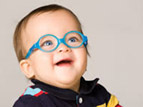
 Many parents are concerned about how they will be able to ensure that their child will comply and wear their glasses. One optometrist commented that "if a child needs glasses, she will wear them because kids like to see their world clearly”. While this may be true for some children, it may not be that simple for others. Initially, some children will demonstrate resistance, but patience, encouragement and a positive attitude should help. With guidance from the optometrist, including the child in the choice of the frame helps him to feel invested in the need for glasses. Frames come in all shapes and sizes. Choose one that fits comfortably but securely. There are devices available to keep glasses in place, a good idea for active children and young children with flat nasal bridges. Cable temples, which wrap around the back of the ears, are good for toddlers. Infants may require a strap across the top and back of the head instead of earpieces. Flexible hinges hold glasses in position, allow the glasses to "grow” with the child, and prevent the side arms from being broken.
With some children, setting a time when they need to wear their glasses and slowly increasing it will allow them to adjust gradually. If the child feels self-conscious or expresses concerns about being teased or bullied, it may help him to identify with a hero who wears glasses, such as a sporting hero or movie star. Harry Potter helped many children to feel comfortable wearing glasses! Most children should adjust to glasses and appreciate their improved vision within two weeks, but if they continue to complain that the glasses feel uncomfortable or they are unable to see clearly, a return visit to the optometrist may be necessary.