NO SCREEN REQUIRED
 |
||||
|
Dreams are one of the most fascinating and mystifying aspects of sleep. Since Sigmund Freud helped draw attention to the potential importance of dreams in the late 19th century, considerable research has been conducted to unravel both the neuroscience and psychology of dreams. Despite this advancing scientific knowledge, there is much that remains unknown about both sleep and dreams. Even the most fundamental question — why do we dream at all? — is still subject to significant debate. While everyone dreams, the content of those dreams and their effect on sleep can vary dramatically from person to person. Whatever the content of our dreams, they often feel incredibly visual, like watching a movie in our minds, complete with special effects, flashbacks, and the occasional plot twist that makes no sense at all. We see vivid, and often strange, images, thoughts, and feelings that can involve all of our senses, including sight, sound, and touch. Dreams are highly visual, incorporating people, faces, places, and objects, but can also include sounds, smells, and tastes. Certain medications, stress, or even lack of sleep can make dreams feel more intense or unusual. What is actually happening to our eyes and brain when we dream?
When we dream, our brain is actually creating those images, not our eyes. During a phase of sleep called REM (Rapid Eye Movement) sleep, which, as the name suggests, is when our eyes move rapidly under our eyelids, the visual parts of our brain light up as if we were seeing real images. But there is no light entering the eye. The brain is drawing from memory, imagination, and emotion to “paint” these dreamscapes internally. The visual content is created entirely by the brain. The eye movements during REM sleep are fascinating too. Scientists suggest that they might correspond to where you’re looking in your dream. For example, if you’re dreaming of walking through a forest, your eyes may dart around as if scanning the trees. This is a reminder that even though your eyes are closed, they’re still active participants in your nightly adventures. |
||||
|
How often do we dream?
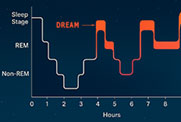
On average, most people dream for around two hours per night. Dreaming can happen during any stage of sleep, but dreams are the most prolific and intense during the REM stage. During the REM sleep stage, brain activity ramps up considerably compared to the non-REM stages. REM sleep is not distributed evenly through the night. The majority of REM sleep happens during the second half of a normal sleep period, which means that dreaming tends to be concentrated in the hours before waking up. |
||||
|
What are the dreams like for people with vision loss? People who become blind after birth often continue to “see” images in their dreams because their brain still remembers how to generate them. But those who are born blind typically don’t experience visual images. Instead, their dreams are rich in other senses: sounds, touch, taste, and smell. For them, a dream might feel like hearing music, feeling textures, or moving through space, just as vivid as visual images, but in a different sensory language. Do we dream in colour? Most people dream in colour, while others report dreams in black and white. Are there different types of dreams?
Dreams can take on many different forms. Lucid dreams occur when a person is in a dream while being actively aware that they are dreaming. Vivid dreams involve especially realistic or clear dream content. While there are similarities between nightmares and bad dreams, bad dreams are normal and usually benign, while a nightmare is a bad dream that causes a person to wake from sleep. Frequent nightmares may interfere with sleep and affect daytime mood. Recurring dreams involve the same imagery repeating in multiple dreams over time. Dreams during REM sleep are typically more vivid, fantastical or bizarre even though they may involve elements of waking life. By contrast, non-REM dreams tend to involve more coherent content that involves thoughts or memories grounded to a specific time and place. |
||||
|
Why do we dream? There are a number of different theories around this. Dreaming has been associated with consolidation of memory, which suggests that it may serve an important cognitive function of strengthening memory and information recall. Another theory proposes that dreams help us to engage with and process our emotions. Periods of dreaming could be the brain’s way of clearing away unnecessary information. Dream content may be a form of distorted instant replay in which recent events are reviewed and analysed. A further view holds that dreaming is just a by-product of sleep that has no essential purpose or meaning. Experts in the fields of neuroscience and psychology continue to conduct experiments, but even with ongoing research, it may be impossible to conclusively prove any theory for why we dream. Is there any other purpose of dreams?
Dreaming plays a role in eye comfort and brain health. REM sleep helps keep the muscles that move the eyes flexible and strong. It is one of the reasons good quality sleep contributes to overall eye comfort and reduces that gritty, dry feeling we sometimes get after a poor night’s rest. Next time you wake up from a vivid dream, take a moment to appreciate what just happened: your brain and eyes working together to create a private film just for you! Sleep well, dream vividly, and keep those eyes healthy! |
||||